|
|
|
|
|
|
|
|
What Is Islam?
Can we find an explanation for the great universe? Is there any convincing interpretation of the secret of its existence? We realize that no family can function properly without a responsible head, that no city can prosperously exist without sound administration, and that no state can survive without a leader of some kind. We also realize that nothing comes into being on its own.
Moreover, we observe that the universe exists and functions in the most orderly manner, and that it has survived perhaps billions of years. Can we, then, say that all this is accidental and haphazard? Can we attribute the existence of man and the whole world to a mere chance? Man represents only a very small portion of the great universe, and if he can make plans and appreciate the merits of planning, then his own existence and the survival of the universe must also be based on a planned policy.
This means that there is a designing will behind our material existence, and that there is an extraordinary power to bring things into being and keep them moving in order. In the world there must be a great force in action to keep everything in order. In the beautiful nature there must be a Great Creator who makes these great pieces of art and produces everything for a special purpose in life.
The deeply enlightened people recognize this Creator and call Him Allah. He is not a man because no man can create or make another man. He is not an animal, nor is He a plant. He is neither an idol nor is He a statue of any kind, because none of these things can make itself or create anything else. He is different from all these things, because He is the Maker and Keeper of them all. The maker of anything must be different and greater than the things that he makes.
There are various ways to know Allah and there are many things to tell about Him. The great wonders and impressive marvels of the world are like open books in which we can read about Him. Besides, Allah comes to our aid through the many Messengers and Revelations He has sent down to humanity. These Messengers and Revelations tell us everything we need to know about our Creator.
The complete acceptance of the teachings and guidance of our Creator as revealed to all His messengers (‘alaihimus salaam) is the religion of Islam. Islam enjoins faith in the oneness and sovereignty of Allah, which makes man aware of the meaningfulness of the universe and of his place in it. This belief frees the human being from all fears and superstitions as it makes him conscious of the presence of Allah Almighty, and of his obligation towards Him.
This faith must be expressed and tested in action, for faith alone is not enough. Belief in one God requires that we look upon all humanity as one family under the universal omnipotence of the Creator, and Nourisher of all. Islam rejects the idea of a chosen people while on the other hand, it approves that belief in the Creator, and doing righteous deeds is the only way to Heaven. Thus, a direct relationship is established with Allah and without any intercessor at that.
Islam is not a new religion. It is, in essence, the same message and guidance which Allah revealed to all His Prophets, like Adam, Enoch, Noah, Abraham, Ishmael, Isaac, David, Moses, Jesus and Muhammad (‘alaihimus salaam). But the message which was revealed to Prophet Muhammad (sallAllahu ‘alaihi wa sallam) is Islam in its comprehensive, complete and final form.
The Qur'aan is the revealed words of Allah and the basic source of Islamic teachings and Laws. It deals with the basis of creeds, morality, history of humanity, worship, knowledge, wisdom, man’s relationship with God, and human relationships in all aspects. It contains comprehensive teachings of which, can be built sound systems and social justice, economics, politics, legislation, jurisprudence, law and international relations, all of which are important contents of the Qur'aan.
The hadeeth, which contains the teachings, sayings, approvals and actions of Prophet Muhammad (sallAllahu ‘alaihi wa sallam) meticulously reported and collected by his devoted companions, explains and elaborates on the Qur'aanic verses.
-----------------------------------------
Arkaanul-Eeman: The Fundamental Articles Of Faith In Islam (The Beliefs).
The true faithful Muslim believes in the following principal articles of faith:
1. Belief in one God (Allah), Supreme and Eternal, Infinite and Mighty, Merciful and Forgiving, the Creator and the Provider, He begets not, nor was He begotten, and there is none equal or comparable unto Him.
2. Belief in all Messengers of Allah (Ar-Rusul) without any discrimination among them, as every known nation had a Warner or Messenger from Allah. They were chosen by Allah to teach humanity and deliver His Divine message. The Qur'aan mentions the names of some of them, and Muhammad (sallAllahu ‘alaihi wa sallam) stands as the Last Messenger and the crowning glory of the foundation of prophethood.
3. Belief in all original scriptures and revelations of Allah (Al-Kutub), accepting them as the guiding light that the messengers received to show their respective people the right path to Him. In the Qur'aan, special reference is made to the books of Abraham, Moses, David and Jesus (‘alaihimus salaam), but long before the revelation of the Qur'aan to Muhammad (sallAllahu ‘alaihi wa sallam) some of these books and revelations had been lost or corrupted. The only authentic and complete book of Allah in existence today is the Qur'aan, which has been preserved as it was revealed to Prophet Muhammad (sallAllahu ‘alaihi wa sallam) in its pristine, pure form.
4. Belief in the Angels (malaa-ikah) of Allah, recognizing them as spiritually pure and splendid beings whose nature requires no food, drink or sleep. They are honored servants who are assigned certain functions, and spend their days and nights in the worship of Allah. They do not speak before Allah does, and they act only by His command.
5. Belief in the Last Day (Yaum Al-Qiyaamah) and the Hereafter (Al-Aakhirah), acknowledging that this world will end someday, and that the dead will rise to stand for their final and fair trial. People with good records will be generously rewarded and warmly welcomed to the Heaven of Allah, and those with bad records will be punished and cast into Hell and none will be treated with injustice.
6. Belief in Fate (Qadr), whether good or bad, which Allah, measured and ordained for all creation according to His previous knowledge, and as deemed suitable by His wisdom. And in the timeless knowledge of Allah, and in His power to plan and execute His plans, nothing could happen in His Kingdom against His will. His knowledge and power which are always in action command over His creation. He is Wise and Merciful, and whatever he does must have a meaningful purpose. If this is established in our minds and hearts, we should accept with good faith all that He does, although we may fail to understand it fully, or think it is bad.
Faith without action and practice is a dead end as far as Islam is concerned, for faith by nature is very sensitive and can be most influential. When it is out of practice or out of use, it quickly loses its liveliness and motivational power.
------------------------------------------------
Arkaanul-Islam: The Five Pillars Of Islam (The Actions)
1. Shahadatain (Testimony): To bear witness that there is none worthy of worship except Allah (The Creator), and that Muhammad (sallAllahu ‘alaihi wa sallam) is His Messenger. Muslims are obliged to follow his exemplary life as a model.
2. Salaah: Daily prayers are offered five times a day as a duty towards Allah. They strengthen and enliven the belief in Allah and inspire man to a higher morality. They purify the heart and prevent temptation towards wrong-doings and evil things. They are:
I. Salaatul-Fajr (The Dawn Prayer)
II. Salaatul-Dhuhr (The Noon Prayer)
III. Salaatul-Asr (The Afternoon Prayer)
IV. Salaatul-Maghrib (The Sunset Prayer)
V. Salaatul-Isha (The Evening Prayer)
3. Zakaah (Charity): The literal and simple meaning of Zakaah is purity, while its technical meaning designates the annual amount in kind or cash that a Muslim with means must distribute among the rightful beneficiaries from his yearly net savings. But the religious and spiritual significance of Zakaah is much deeper and more valuable than its humanitarian, and socio-political value.
4. Sawm (Fasting): The Muslims during the month of Ramadhaan do not only abstain from food, drink and sexual intercourse from dawn to sunset but they are also required to refrain from evil intentions and desires throughout the whole months of the year in general, and during the month of Ramadhaan in particular. It teaches love, sincerity and devotion, and develops a sound social conscience, patience, selflessness and will power as well.
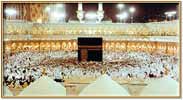
5. Hajj (Pilgrimage to Mecca): It is to be performed once in a lifetime, so long as one can afford it financially and physically, and it is the largest annual convention of faith where Muslims meet to know one another, study their common affairs and promote their general welfare without prejudice or bias as to one's color, race, nationality as well as status in life. After all, everyone is equal in the sight of Allah, and so Hajj therefore demonstrates in effect the universality of Islam and the brotherhood and equality of Muslims.
ï® THIS IS ISLAM
ï® THE TRUE WAY FOR SUCCESS
ï® IN THIS LIFE AND IN THE LIFE HEREAFTER
At present there are 1.5 billion Muslims worldwide and they form the majority in more than 50 countries of the world. Today Islam is the fastest growing faith in the world - its beautiful message is reaching millions in the far corner of the earth.
Muslim Festivals
For Muslims all religious festivals have their own special significance. In fact, at the end of different modes of worship, Islam has instituted a kind of festival. The festival following the daily Prayers of the week is Jum'a-tul-Mubarak (Friday); the one following the month of fasting is called Eid-ul-Fitr, while the festival following the ceremony of Hajj at the Ka'aba in Arabia is know as Eid-ul-Adhia.
Following is a list of Muslim Festivals:
Jum'a-tul-Mubarak (Friday Prayer)
Eid-ul-Fitr
Eid-ul-Adhia
Muharram
Eid Milad-un-Nabi
Shab-i-Miraj
Lailat-ul-Qadr
Insert Another Sub Header Here
Jum'a-tul-Mubarak
Of all the religious obligations of a Muslim, the most important is Prayer of Salat. It is compulsory for all Muslims, men and women equally. The Holy Quran states:
"Observe Prayer in the prescribed form. It is enjoined on the believers to be performed at its appointed times." (4:104)
All the compulsory Prayers should be performed in congregation if possible. On Friday, however, a special mid-day Prayer Service is held in place of Zuhr Prayer. This is called Jum'a Prayer. Of all the Prayers, none is so essential to be offered in congregation as the Jum'a Prayer. The Jum'a, in fact, is the greatest Muslim festival.
Muslims are asked to leave all their worldly pursuits when they are called tothe Friday Prayer, and assemble in mosque to offer this Prayer with due observence of all its requirements. The Holy Quran states:
O ye who believe, when the call is made for Prayer on Friday, hasten to the rememberance of God and leave off all business, that is better for you, if you only knew. (62:10)
The Holy Prophet (peace be upon him) said:
"Your best day is Friday, so you should be diligent on that day in calling down blessings on me, for your blessings are conveyed to me." (Sunan Abu Daud)
"The best of days on which sun rises is Friday; on that day was Adam created, on that day he was admitted to the Garden and on that day was he expelled therefrom." (Muslim)
In regards to the preparation for Friday Prayer Service, the Holy Prophet (peace be upon him) said:
"A Muslim takes a bath on a Friday, makes himself thoroghly clean, and uses scented oil or just some perfume. Having thus freshened up, he goes to the mosque. He occupies a place without disturbing people sitting on his right and left. He offers the prescribed prayers, and when the Imam appears, he listens to him in silence. May God forgive his sins between that Friday and the last." (Bukhari)
Abu Hurairah, may Allah be pleased with him, relates that concerning Friday the Holy Prophet, peace be upon him, said:
"There is on that day a brief period of time during the service when whatever supplication a Muslim servant of Allah makes is granted." He indicated with his hand that the period is very short. (Muslim)
Abu Said Khudri, may Allah be pleased with him, relates that hte Holy Prophet, peace be upon him, said:
"Bath on Friday is obligatory on every adult Muslim." (Muslim)
Ammar bin Yasir, may Allah be pleased with him, relates that he heard the Holy Prophet, peace be upon him, say:
"The length of a person's Prayer and the brevity of his sermon testify to his intelligence. Make your Prayer long and your sermon short." (Muslim)
Eid-ul-Fitr
Eid is an Arabic word which means "a day which returns often."
Eid-ul-Fitr is celebrated on the 1st day of the month of Shawwal. The month of Shawwal start after the month of fasting, that is why it is also called the festival of the breaking of the fast. Fasting in the month of Ramadhan is one of the five pillars of Islam. It is, therefore, a practical requirement of the faith and is regarded as and act of devotion.
While Eid is an occasion for joy and happiness, it is certainly not an occasion to indulge in frivolity, over-eating and mere pursuit of pleasure. The main purpose is always to seek the pleasure of Allah almighty by glorifying Him and rendering thanks to Him for having enabled them to perform their duties duly.
Sadaqat-ul-Fitr or Fitrana
On such an auspicious and festive occasion, Muslims are specially reminded of their obligations towards the poorer section of society. A special contribution called 'Sadaqat-ul-Fitr' or 'Fitrana' is fixed for this purpose. The contribution should be paid by the head of the family on behalf of all the members of the family. It is desireable to pay this contribution before the Eid service in order to enable the poor to join in the festivities of the day.
Eid-ul-Adhia
Eid-ul-Adhia is a festival that is celebrated on the 10th of Dhul Hijja and marks the close of the Hajj ceremony or Pilgrimage to the Ka'aba.
A Muslim is required to perform the pilgrimage at least once in his lifetime, provided that he can afford the cost of the journey, is not indebted to anyone and is not otherwise prevented from performing the Haj. Those who unable to perform the pilgrimage join in the Eid-ul-Adhia ceremony at their own places.
The Eid is celebrated with great solemnity and reverence everywhere. Like Eid-ul-Fitr, Muslims make preparations several days before the festival. The animals to be sacrificed are bought well before the Eid day by those who can afford to do so. These animal should be free from all physical defects and should be fully grown. In case of sheep, goat or lamb, one animal suffices for one household, while a cow or a camel can be shared by upto seven families.
On the day of the Eid, Muslims assemble in the Eid-gah or in the large mosques of the town for Eid Prayer Service. The Eid Prayer is comprised of two Raka'as and offered in the same manner as Eid-ul-Fitr. Generally no breakfast is served on this Eid, and those who offer sacrifice do not eat anything until after they have sacrificed the animal. After the prayer the Imam delivers a sermon in which he explains the significance of the festival, giving the details of the sacrifices offered by Abraham, his wife Hager and their son Ishmael. Returning by a different route and singing the praise of Almighty Allah, Muslim worshippers return home and slaughter their animals. On Eid day, Muslims recite the praise of Allah in the following words:
Allah ho Akbar, Allah ho Akbar
La illaha illa Allah, wa Allah ho Akbar, Allah ho Akbar
wa Lillah hil Hamd
Translation:
Allah is the Greatest, Allah is the Greatest
There is none worthy of worship except Allah and
Alah is the Greatest, Allah is the Greatest and
All praise belongs to Allah
The person who offers the sacrifice is allowed to use a portion of the meat, the remainder is distributed among the relatives, friends, neighbors and the poor. The animals my be sacrificed on the day of the Eid or the two days that follow. Millions of animals are slaughtered all over the world on this occasion. The skins of the slaughtered animals are sold and the proceeds given to different charities.
Philosophy of the Sacrifice:
According to the teachings of Islam, the sacrifice of animals is not offered to appease offended deities nor to win their favor as an atonement of sins as was the case of many other nations. The Holy Quran made it quite clear by stating:
"Neither the flesh nor the blood of your sacrifices reaches God, but it is the righteous motive underlying them that reaches Him." (22:37)
In other words, the slaughtering of animals is a symbolic expression whereby a Muslim declares his readiness to lay down his own life and everything he owes for the sake of God Almighty. The animal that is sacrificed really stands for the animal in man himself.
Muharram
Muharram festival commemorates the martyrdom of Hazrat Imam Hussain, the grandson of the Holy Prophet (peace be upon him). This festival starts at the 1st day of Muharram and lasts for 10 days until 10th of Muharram. Muharram is the first month of Islamic calendar.
During this month, while on a journey, Hazrat Imam Hussain, his family members and a number of his followers were surrounded by the forces of Yazid, the Muslim ruler of the time. During the siege, they were deprived of food and water and many of them were put to death. The incident happened at a place called Karbala in Iraq in 61st year after Hijra. This dispute was result of a disagreement among Muslims on the question of succession after the demise of Hazrat Ali, the fourth caliph.
Some sects of Muslims hold meetings where speeches are made on the happenings of Karbala and on the lives of martyrs. The Shias, however, observe this festival in a different fasion. As Muharram, the first month of the Muslim year, approaches, they put on black clothes, as black is regarded as a color of mourning. Majalis (assemblies) are held every day during the first nine days where shia orators relate the incident of the martyrdom of Hazrat Imam Hussain and his party in a great detail. On the 10th day of Muharram, large processions are formed and the devoted followers parade the streets holding banners and carrying models of the mausoleum of Hazrat Imam Hussain and his people, who fell at Karbala. They show their grief and sorrow by inflicting wounds on their own bodies with sharp metal tied to chain with which they scourge themselves. This is done in order to depict the sufferings of the martyrs. It is a sad occasion and everyone in the procession chants "Ya Hussain", with loud wails of lamentation. Generally a white horse beautifully decorated for the occasion, is also included in the procession, to mark the empty mount of Hazrat Imam Husain after his martyrdom.
During these first ten days of Muharram, drinking posts are also set up temporarily by the Shia community where water and juices are served to all, free of charge.
Eid Milad-un-Nabi
Allah sends down his blessings on the Prophet, and His Angles constantly invoke His blessings on him; do you, O believers, also invoke Allah’s blessings on him and offer him the salutation of peace.’ (33:57)
A large number of Muslims do not believe in celebrating birthdays of death anniversaries because there is no historical evidence that such was the practice of the Holy Prophet. However, similarly large number of Muslims do commemorate the birth anniversary of the Holy Prophet on 12 Rabi-ul-Awwal of the Islamic lunar calendar year. For Muslims, this date marks the most important event in the history of the mankind because the Holy Prophet Muhammad (peace be upon him) is regarded as the Chief of the Prophet, to whom the Holy Quran was revealed.
The extent of the festivities, on this occasion, is restricted because of the fact that the same marks the death anniversary of the Holy Prophet (peace be upon him) as well.
On this occasion public meetings are held in the mosques where religious leaders and scholars make speeches on different aspects of the life of the Holy Prophet (peace be upon him). The stories of the Prophet’s birth, childhood, youth and adult life, his character, teachings, sufferings, and forgiveness of even his most bitter enemies, his fortitude in the face of general opposition, leadership in battles, bravery, wisdom, preaching and his final triumph through Allah’s mercy over the hearts of people are narrated in detail. Salutations and songs in his praise are recited. In some countries, streets, mosques and buildings are decorated with colorful buntings and pennants and well illuminated at night. Affluent Muslims generously donate to charity. Feasts are arranged and food is served to guests and the poor.
Shab-e-Miraj
Shab-i-Miraj means the night of Ascent. It is the blessed night when the Holy Prophet of Islam was spiritually transported to heaven and he reached a high stage of nearness to God Almighty which is beyond ordinary human comprehension. The Ascent took place on 27th day or Rajab, 2 years before Hijra. The journey was not with a physical body but was a vision of the highest type. On the way the Holy Prophet, peace be upon him, met Adam, Abraham, Moses, Jesus and some other Prophets. The purpose of the Ascent was to confirm the high status of the Prophet of Islam, a position which all Muslims believe, is impossible to attain by any other human being. It is related that even Gabriel, the Angel who was accompanying the Holy Prophet remarked at one stage, 'I am forced to stop here. I cannot go any further, but you O Messenger of peace and friend of the Master of the worlds, continue your glorious ascent.'
It is also related that the Holy Prophet continued his journey until he reached very close to the Throne of God Almighty and attained the utmost nearness to Him. After having drunk fully at the Divine fountain of spiritual knowledge he came down to impart the knowledge to mankind.
It was on this journey, that five daily prayers were made obligatory upon Muslims.
Celebrations:
According to popular belief, the Miraj or Spiritual Ascension took place on 27 of Rajab. On this day, in some Muslim countries the houses and streets and specially the mosques are decorated with colorful pennants and buntings, and at night they are well illuminated by means of electric lights, candles or even oil lamps. As evening approaches the worshippers assemble in the mosques and engage themselves in glorifying the Lord and in singing hymns in His praise and in praise of the Holy Prophet. Public meetings are also held generally after Isha Prayer in larger mosques where speakers throw light on the spiritual status of the Holy Prophet, and various aspects of his life. The story of his spiritual ascension is narrated in detail. After the meetings sweets are generally distributed. Muslims of means give money in charity and also distribute food among the poor. The devoted ones spend the whole night in the remembrance of God.
Insert Another Sub Header Here
Concluding Remarks
This is the everlasting, renewable, and living proof. The Qur'aan is the eternal miracle in our hands until the Last Hour. Fourteen hundred years ago, the Bedouin in the desert examined the Qur'aan and found in it divine knowledge, which he recognized as from his Lord and which confirmed the veracity of the message of Prophet Muhammad (sallallahu ‘alaihi wa sallam).
Today, scientists in the various disciplines of natural sciences who study the Qur'aan find that this same divine knowledge, is providing them with the same evidence and confirms that it is from the creator of the universe. Likewise, the evidence confirms the genuineness of Prophet Muhammad (sallAllahu ‘alaihi wa sallam). We have met with a number of these scientists, some of whom have affirmed that this knowledge could not have come from a human source.
Professor Dorja Rao: It is difficult to imagine that this type of knowledge was existing at that time, around 1400 years back. Maybe some of the things they have simple ideas about, but to describe those things in great detail is very difficult. So, this is definitely not a simple human knowledge.
Some of them say that this knowledge can only be from outside of this universe.
Professor Armstrong: There may well have to be something beyond what we understand as ordinary human experience to account for the writings that we have seen.
Professor Dorja Rao : So, I thought the information must have come from a supernatural source.
Some of them came forward fearlessly and affirmed that this knowledge can only be from Allah, the Creator of the Universe.
Question: Then from whom do you think is the source of such information?
Professor Hay: Well, I think it must be the Divine Being.
Professor Kroner : ...modern scientific methods are now in a position to prove what Muhammad said 1400 years ago.
Professor Marshall Johnson : I see nothing here in conflict with the concept that divine intervention was involved in what he was able to write.
Professor Shroeder : Actually, the scientists are now discovering what has been said before.
Professor Persaud : I have no difficulty in my mind in concerning that this is a divine inspiration or revelation which led him to relay the statement.
Some of them concluded their affirmation by saying:
Professor Keith Moore : It is clear to me that these statements must have come to Muhammad from Allah, because almost all of this knowledge was not discovered until many centuries later. This proves to me that Muhammad must have been a messenger of Allah.
Some of them declared the shahaadah and embraced Islam!
Professor Tejasen : I think this is the time to say: There is no god worthy of worship except Allah and that Muhammad is His Messenger!
There is no doubt that the Qur'aan is the eternal miracle in our possession. Allah has said in the Qur'aan:
Say: What thing is most weighty in evidence? Say: ‘Allah is witness between me and you; this Qur'aan has been revealed to me by inspiration. That I may warn you and all whom it reaches’. (Qur'aan 6:19).
Thus, whoever has been informed of this Qur'aan likewise, bears the testimony and warning. The nature of this testimony is the scientific affirmation that each verse in the book of Allah contains. Each verse contains divine knowledge. In each century, scholars make new advances in their various fields.
Allah has said:
But Allah bears witness that what He has sent unto thee He has sent with His (Own) knowledge. (Qur'aan 4:166).
The Qur'aan is the miracle which renews itself in a way which is appropriate for each epoch. Allah has said:
For every prophecy is a limit of time, and soon shall you know it. (Qur'aan 6:67).
With This We Conclude And May Allah Accept It As Done Sincerely For His Sake, Ameen
-----------------------------------------------------------
|
|
|
Insert Another Sub Header Here
Insert descriptive text which supports the above header. Insert descriptive text which supports the above header.
Insert descriptive text which supports the above header. Insert descriptive text which supports the above header.
Insert Another Sub Header Here
Insert descriptive text which supports the above header. Insert descriptive text which supports the above header.
Insert descriptive text which supports the above header. Insert descriptive text which supports the above header.
Insert Another Sub Header Here
Insert descriptive text which supports the above header. Insert descriptive text which supports the above header.
Insert descriptive text which supports the above header. Insert descriptive text which supports the above header. |
 |
|













